
Brief History of the pipa
Updated: Aug 29
China is an ancient country that has seen a wide variety of changes and evolutions over thousands of years. Though some cultural aspects have endured through the ages, few have survived from ancient times as a cultural staple like the ancient, plucked instrument: the pipa 琵琶
Early Origins: The Pipa in
2nd‑6th Centuries CE (Late Han
to Northern‑Southern Dynasties)
Deriving from its foreign predecessor, the barbat, a short‑necked pear‑shaped plucked lute from Central‑Asia / Persia, the pipa entered China between the 2nd and 6th centuries CE. Merchants, migrant musicians, and cultural exchanges along the Silk Road first brought the instrument into northern China.

During the periods of the Eastern Han, Three Kingdoms, Jin, and the Northern and Southern Dynasties, it gradually established itself among elite and popular music circles, laying the foundation for its later Tang‑dynasty golden age.
In its earliest Chinese form (2nd‑4th centuries), the curved‑neck pipa was held horizontally across the player’s lap. Musicians plucked its four silk strings with a hard bone or wooden plectrum, not bare fingernails, and had relatively few frets. The term “pipa” is often explained as an onomatopoeia: pi 琵 for plucking forward, pa 琶 for plucking backward, describing its core performance gestures. Though the origin of the name is commonly accepted, some scholars argue the word derives from a pre-existing word from Central‑Asia.

During the 4th‑6th centuries, amid political division of the Northern and Southern Dynasties, northern non‑Han ruling courts favored foreign musical styles. The pipa became a key instrument for hu yue (“barbarian / foreign music”), performed in palace banquets, ritual entertainment, and folk ensembles.
Southern Chinese regions were slower to adopt the pipa, making it more associated with northern, imported musical styles, rather than older, native Han music. Eventually by the end of the 6th century, on the eve of Sui‑Tang unification, the curved‑neck pipa was firmly integrated into Chinese musical life.
Historical evidence still remains today, such as visual evidence from tomb reliefs, brick paintings, and early literary records confirm its growing presence in China. Though most surviving references are textual and pictorial, unfortunately, almost no physical instruments or complete musical scores from this era remain.

Tang Dynasty: the golden age
(618‑907 CE)
For many scholars, the Tang Dynasty represents the undisputed golden age of early pipa art. Benefiting from the dynasty’s cosmopolitan openness, prosperous Silk Road trade, and flourishing court entertainment, the pipa was fully able to integrate into Chinese music culture, rising to elite prominence, and achieving unprecedented artistic maturity. During these three centuries, the pipa transformed from a folk instrument of foreign origin, into the leading solo and ensemble instrument of imperial court music, laying the ground work for the core performance aesthetics and technical foundation for all later pipa traditions to come.
In Tang courts, the pipa became the central instrument of huyue (foreign music), a fashionable multicultural genre absorbed from Central Asian and Persian musical traditions. Professional foreign musicians from Kucha (now a region in modern Xinjiang province) and Sogdiana (an ancient Iranian civilization that spread across modern Uzbekistan, Turkmenistan, Tajikistan, Kazakhstan, and Kyrgyzstan), were highly valued in the capital city of Chang’an.
Unlike indigenous Han musical instruments associated with the era’s rituals and Confucian elegance, the Tang pipa was celebrated for its vibrant, dramatic, and virtuosic tone, matching the dynasty’s extravagant aesthetic. The pipa was widely utilized in both official court ensembles and urban entertainment quarters, gaining popularity among nobles, scholars, and common citizens alike. Pipa performance eventually became so prominent, it solidified itself as an essential part of grand imperial banquet music, dance dramas, and large‑scale ensemble suites known as daqu.
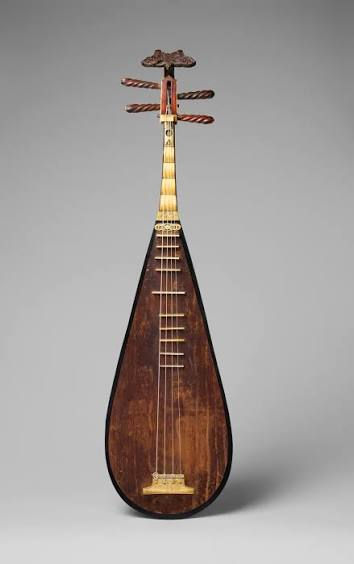
Instrument structure and performance technique underwent revolutionary changes during the Tang period. The standard Tang pipa featured four strings and a pear‑shaped body, larger and fuller than modern versions, but still with fewer frets than a modern pipa. Early Tang performers continued the traditional Silk Road style: holding the instrument horizontally and plucking with a wooden or bone plectrum. A five-string pipa also became common place during this time.
As a pipa culture sprouted and grew, gradually throughout the dynasty, the instrument underwent landmark changes: shifting from plectrum to fingernail plucking, and adjusting the posture to an upright, thigh‑resting position. This critical transition greatly enriched tonal variation, flexibility in articulation, and expressive subtlety. This formed the basic physical technique system of Chinese pipa performance that is still used today. Regional performing schools also emerged, including palace entertainment and folk‑style schools, diversifying musical styles and repertoire.
Visual and literary records abundantly document Tang pipa prosperity. Thousands of musical murals in the Dunhuang Mogao Grottoes (in modern Gansu province) have preserved vivid images of Tang pipa players, flying apsaras, and ensemble scenes, offering direct archaeological evidence of the instrument’s central role in religious and secular entertainment.
Now considered a classic poem, Pipa Xing 琵琶行 (Song of the Pipa Player) by Tang poet Bai Juyi 白居易, comprehensively depicts the instrument’s dramatic timbre, rich musical narrative, and professional performance culture in the hands of an elegant lady of court.
The Tang dynasty also initiated a cross‑border cultural diffusion. As part of the Tang cultural exportation, the pipa spread to Japan, Korea, and Vietnam, evolving into the local traditional instruments: the Japanese biwa, Korean bipa, and Vietnamese tỳ bà. A physical instrument of the period still exists, and is stored in the Shosoin Temple Repository in Japan’s ancient capital of Nara. The masterfully crafted five string pipa is an example that demonstrates the superb lutherie and luxurious aesthetic of high‑grade Tang pipas. While these regional variants gradually developed because of independent national musical traditions, these instruments still retain Tang instrumental features to this day.
By the late Tang period, the five‑string pipa, popular in early and mid‑Tang music, gradually faded from use, leaving the four‑string pipa as the dominant standard inherited by subsequent Chinese dynasties.
Song, Ming and Qing dynasties
(10th‑19th centuries)
After the collapse of the Tang dynasty, the pipa faded from its dominant position at court, and was reshaped by folk, theatrical and literate‑musical traditions across the Song (960‑1279), Ming (1368‑1644) and Qing (1636‑1912) dynasties. While imperial huyue foreign‑music ensembles disappeared, the instrument found new creative spaces in urban popular culture, regional performing schools, and in the literate realm of written score.
During the Song dynasty, court musical institutions shrank, and the pipa moved largely out of grand palace banquets. It became more of an accompanying instrument for narrative storytelling, opera, and chamber folk ensembles in cities. Though little innovation was seen during the Song dynasty, luthiers still made improvements by gradually increasing the number of frets, allowing the instrument’s pitch range and repertoire to expand.
Compared with the flamboyant virtuosity celebrated by Tang writings, Song‑era aesthetic tastes leaned toward more restrained, and delicate expression. Few original pipa scores survive from this period, with most music derived and restored from poetry, paintings and historical documents. The five‑string pipa, still seen in the late Tang dynasty, virtually vanished, leaving the four‑string pear‑shaped pipa as the sole standard.
Throughout the Ming dynasty, pipa practice flourished among amateur literati and professional street performers alike. Instrument craftsmanship further improved. Distinct regional stylistic lineages began to take shape, laying groundwork for the formal schools of the Qing dynasty. Pipa started to accompany southern drama and storytelling, alongside growing numbers of standalone solo instrumental pieces. Oral transmission remained primary method of dissemination, though hand‑copied manuscripts of solo repertory started to circulate among master to student groups.
The Qing dynasty marked the high point of traditional pipa school culture. Famous regional schools emerged, including the Wuxi, Pinghu, Shanghai, and Zhe. Each school maintained its own interpretations, ornamentation habits, favored pieces, and teaching lineage. Some schools emphasized grand, powerful battle‑themed works, while others focused on gentle, lyrical chamber‑style music.
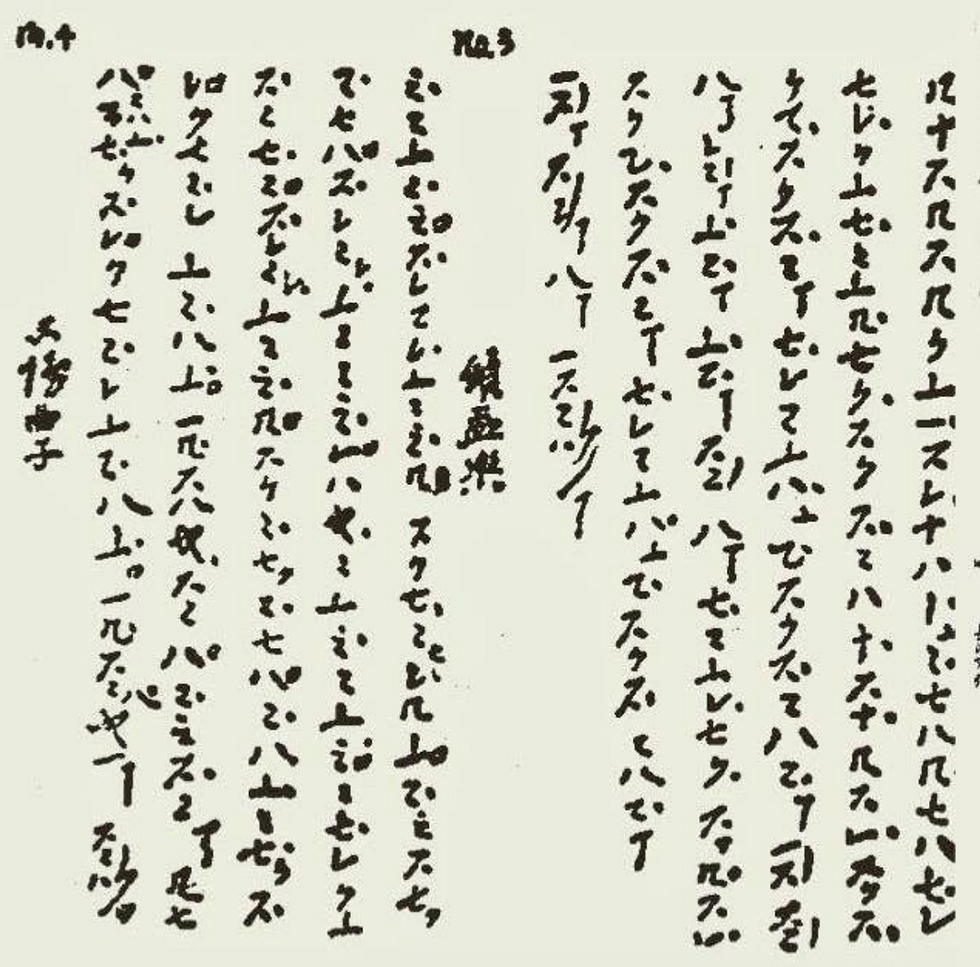
A landmark moment arrived in 1818, when Hua Qiuping’s Pipa Scores (Hua Qiu‑ping Pipa Pu) was printed. This is the earliest major collection of pipa scores published. It preserved masterpieces such as Ambush from All Sides (Shi Mai Fu) and The Warlord Takes off His Armour (Ba Wang Xie Jia), two iconic battle‑genre works. Printed and hand‑copied scores helped stabilize repertoire, even though improvisation and individual variation still remained essential to performance.
Through these centuries, the pipa transformed from a cosmopolitan court showpiece into a carrier of Chinese regional folk art. The repertories, schools, and notational practices developed in the Song, Ming, Qing dynasties became the core foundation for 20th‑century conservatory pipa education.
Twentieth‑century
transformation (1912-2000)
The 20th century brought sweeping institutional, technical, and compositional changes to the pipa. Moving away from master‑apprentice folk transmission, the instrument entered modern conservatory education, underwent physical redesign, acquired a large body of newly‑written repertoire, and secured its place as the leading solo instrument on the modern Chinese concert stage.
In the early decades of the 1900s, traditional pipa remained rooted in regional folk schools. Performers still used older instruments with fewer frets and silk strings. Teaching continued mostly through the private master to student lineage, rather than formal conservatory training. After the founding of modern Chinese conservatories in the 1920s‑1940s, pipa began to be taught inside formal music institutions. This shift laid the groundwork for standardized teaching methods of a complicated and diverse musical culture.
The pipa masters of the period played a central role in organizing and cataloging more than a millennium of technique and repertoire. Musicians such as Lin Shicheng and Liu Dehai compiled graded etudes, edited traditional scores, and built systematic conservatory teaching syllabi. Oral performance traditions were transcribed into printed notation, creating a standardized set of methods that no longer relied on oral tradition passed down only by memory. Old folk pieces were revised, rearranged, and polished for concert performance.
Mid‑20th‑century luthiers carried out major physical modifications that re‑defined the technical limits of the of the pipa. The number of frets was expanded from around 12‑16 on traditional Qing‑era instruments to 29‑31 frets, allowing for harmonically broader and fully chromatic possibilities. Delicate silk strings were replaced with nylon‑wound metal strings, delivering greater volume, brighter timbre, and better projection for large concert halls. Tuning also became more standardized across the country.
With the new innovations to the pipa and written scores to study, composers started creating original, modern works for the instrument. Pieces blended traditional idioms with 20th‑century harmonic structures, expanded rhythmic patterns, and exemplified dramatic storytelling. Many new works were written for pipa solo or with piano accompaniment, as well as concerti written for large‑scale Western orchestras, and Chinese traditional orchestras.
By the late 20th century, the pipa had transitioned from a regional folk instrument into a virtuosic, concert showpiece. Conservatory‑trained performers began touring internationally, introducing the pipa to global audiences. Though modernization brought greater technical uniformity, some scholars and performers worried that local folk‑school nuances and improvisatory elements risked being lost in standardized conservatory practice, a debate which is still open today.
The Contemporary Era (late
20th century to the present)
From the closing decades of the twentieth century into the twenty‑first, the pipa evolved from a mainly Chinese folk instrument into a globally recognized voice in world music, contemporary classical composition, cross‑genre fusion, and digital media. While more traditional conservatory‑based training has remained dominant, performers and composers have expanded the pipa’s artistic boundaries, with critical debates arising about balancing modern standardization, with older, regional folk traditions.
Within China, conservatory education has continued to standardize technique. Systematic grading systems, printed course books, and large‑scale national competitions have shaped recent generations of pipa performers in a new way. Composers continue producing original solo works, pipa concerti, and chamber pieces that combined traditional idioms with western harmony, counterpoint, and avant‑garde writing.
Though the pipa has expanded, it still maintains its core position in Chinese traditional orchestras, while also appearing in film soundtracks, theatre productions, and popular‑music collaborations. While looking to the future, many music scholars and artists continue to look back, working to rediscover, reconstruct, and record ancient pipa music, seeking to restore oral‑tradition nuances that risked being marginalized by uniform conservatory practice.
Internationally, a cohort of migrant pipa virtuosos became global ambassadors for the instrument. Artists such as Wu Man, Liu Fang, Min Xiao‑fen, Gao Hong and Yang Jing have toured extensively and performed in major concert halls and international music festivals all over the world.
Wu Man in particular has commissioned and premiered a plethora of new compositions for pipa by many leading composers such as Tan Dun and Phillip Glass. Projects, such as the Ghost Opera with the Kronos Quartet, demonstrated how the pipa could integrate naturally within western‑style chamber music, opening a new creative chapter for the instrument.
Today, contemporary performance embraces stylistic diversity. Though some performers focus on faithful interpretations of historic Qing‑era scores and reconstructed Tang‑dynasty fragments such as the Dunhuang pipa manuscripts, others explore experimental fields such as free improvisation, jazz, electronic music, multimedia performance, and cross‑cultural fusion.
The pipa has also continued to proliferate into the realm of streaming platforms, online masterclasses, and video archives, making pipa performance and teaching available to global learners outside formal conservatory systems.
Today, the pipa maintains a dual functionality; thriving as both a living carrier of Chinese historical musical heritage, and a flexible contemporary instrument capable of participating in global creative dialogue.
Sources:
1. Encyclopedia Britannica. “Pipa”. Britannica Academic, 2025.
2. Liu Fang Music. “Pipa – Four-stringed Lute Historical Overview”. liufangmusic.net.
3. Organology.net. “Pipa: Instrument History & Development”. 2024.
4. Frontiers in Science. “The Spread and Evolution of the Pipa on the Silk Road”. 2023.
5. Myers, J.The Way of the Pipa. Kent State University Press, 1992.
6. Moore, J. K. (2003). The Pipa. The Metropolitan Museum of Art, Heilbrunn Timeline of Art History.
7. Provine, R. C., Tokumaru, Y., & Witzleben, J. L. (eds.). (2002). Garland Encyclopedia of World Music, Volume 7: East Asia. Garland Publishing.
Comments