
Reading Pipa Scores
For a western musician, reading the modernized Chinese notation system is no easy task. Simply put, it is a combination of the essential parts of western music notation written out in a similar way to guitar tablature.

Instead of a staff with notes on a series of lines, there are numbers that progress across in one line, with numbers sometimes above and/or below the middle number if there is more than one note being played at a time. These numbers are based off of western scales.
Harmony

Tonality is represented by a number chart that specifies key and/or specific tuning for the music, most of which will follow a western key. 1 = D indicates that the overall piece is in the key of D major. The subsequent numbers would continue with the remaining notes of the key in their corresponding order.
Example: 1= D, 2=E, 3=F#, 4=G, 5=A, 6=B, 7=C#
This will typically be shown at the beginning of every piece as follows.

Here you see the key and also 5, 1, 2, 5. This indicates that the piece is in the standard A, D, E, A tuning. They are also labeled with one, two, or no dots below them.

To differentiate which note is at which place in the harmonic series, dots are used above and below the notes, meaning if in this key you see a 1 (which is D) the dots will tell you in which range the D is, i.e, D1, D2, D3, etc.

The image above displays in which octaves the dots correspond, with the notes for standard tuning boxed in red.

When a key change occurs, the assignment of the numbers will change with it. For example, switching to A major would mean 1=A, 2=B, 3=C#, etc. However, this can get tricky to decipher when reading a pipa score. Before starting a piece, the location of the notes must be identified, meaning which dots are in which octave. Typically, though not always, the score will specify, and all the notes will remain in the same place simply under a different pitch.
In the above example, there key change in the middle of the piece from D to A. Here, is specifies that in D, the top string would be tuned to an A3 (labelled as 5, its place in D), and that the tuning will not change, but now be identified as 1, still an A3 but re-labelled to correspond to its place in A.
Typically, if a piece is in D major, there may be no indication of string order. That is because it is taken as a given that the piece will be in standard tuning. This can also be seen with other keys if the tuning doesn’t change.

Though often, when the key is not in D but in standard tuning, it will simply display the exact same notes but in the order in which they appear in the key.

There are certain pieces where an alternative tuning will be indicated, which is usually just for the bottom string. For those pieces, you may see it written like this:
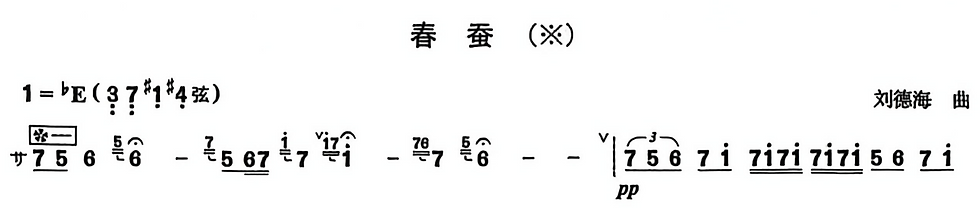
In this case, as 3 does not correspond to A in the key of Eb, it indicates that bottom string is not in standard tuning. In the above example, Spring Silkworm, the piece is in the key of Eb, meaning 3=G. Therefore, the bottom string should be tuned down a step to G2. Normally, the following numbers would be easy to decipher, however, it can frequently be seen in this notation system semi-illogical or completely illogical uses of western harmony.
The second string is easier to decipher, with no markings and 7 easily identified as corresponding to a D in Eb, the pitch is more obvious. However in this specific case, because the second and first strings are in standard tuning (E3 and A3), they should be marked with a natural symbol (as they would be flat in this key), instead of a sharp to indicate the literal pitch the strings are tuned to. In correct use of western harmony, as written above, 1# should mean E# (or F) and A# (or Bb), though in this example they do not.
This could easily lead to confusion, as it would seem strange to re-tune the pipa to G, D, E#, and A#. However in this case, the sharp is being used to raise the tone a half step, as a sharp would be used in practice, meaning, 1# is being used to indicate that the note is E, the sharp raising it a half step from Eb, which 1 equals in the key of Eb. The same logic applies with the top string.

To confuse things further, there can sometimes be more than one version of a piece. This can most commonly be seen with traditional music, however, this piece for example was written in 1985 by Liu Dehai. As can be seen in this version, the top two strings are written with flats instead of sharps, as in the other edition.
Again, from proper use of western harmony, 2b=Fb (with it’s enharmonic being E), which makes more sense than the previous edition. Following it is 5b=Bb (with it’s enharmonic being A#), which does not make sense. This is because, again, the flats are not being used as a note identifier, but to literally lower the note, as the other edition was using a sharp to raise them.
So in this case, 2b=F is using a flat to lower it to E, and the 5b= Bb is using a flat to lower it from Bb, which is what five would be in the key, to an A. Why this logic is used and employed, and further, why there are differences in a modern piece that was scored by a composer, is somewhat of a mystery.
Point being, when there is a key change during the piece or the piece is in an alternate tuning, it is best to observe very carefully how the key is labelled at the beginning to best understand where the notes will be to avoid further confusion when learning the piece.
Notation and Polyphony
Typically, a performer will approach a score by first reading the line of numbers. Each line is read from left to right, top to bottom. When there is more than one note being played at once, the numbers are stacked on top of each other.

In the above example, the notes are stacked in the manner in which the pipa is strung, indicated by the characters below the numbers. Meaning, the top note is executed on the first string, below on the second, etc. However, sometimes the order or the manner in which the notes are written can be confusing or easy to miss all together.
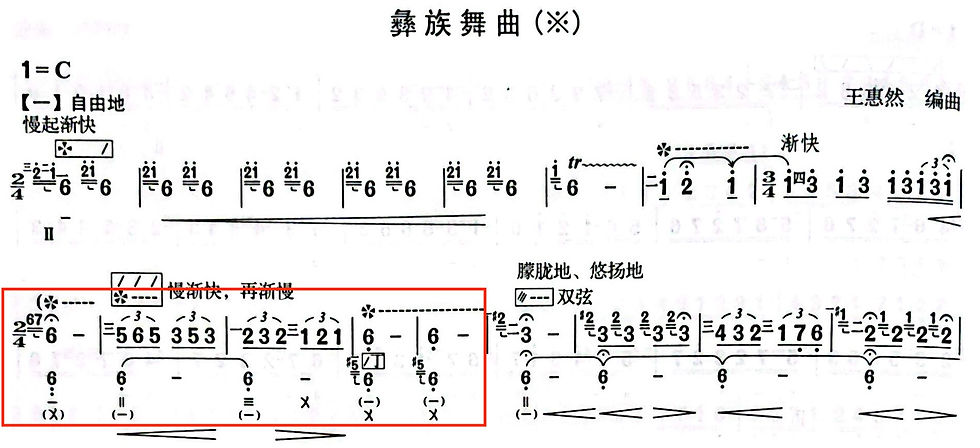
In the red box, starting in the second measure, the middle line is the main melodic line, with a harmonic accompaniment shown below. This may be confusing to initially decipher as the melodic line is played on the second string, while the first string is being used as harmonic accompaniment, which is shown below the main line. It may seem initially illogical for those used to reading a staff, therefore when reading a pipa score pay very close attention to which strings are being indicated below the notes, and the order in which they’re stacked.
This example is fairly simple, however it can become trickier when three or all four strings are being used.

In the above example you can see a melody line that is played between the first three strings. Initially it may be confusing to try and figure out where to play the notes, and again, the string indication is essential. However, string assignment is only noted for the first beat, in which case, a pipa player would continue either with whatever logic is noted and/or play in whatever way allows for smooth transitions.
It is also important to note that the numbering system for strings (below the numbers) and fingerings (above the numbers), share a similar looking one and three. In a cluttered score it can lead to confusion, so it is best to observe carefully where indications are written.
Rhythm
In terms of rhythm, it is used in the same way as western notation without alteration, though there are certain situations where it can be difficult to interpret the actual note.

In the above example, you will see numbers with one line, two lines, or no lines under them. One line indicates an eighth note, two lines indicate a sixteenth note, and no line indicates a quarter note, with a 0 being used to indicate a rest. Thirty second notes (and beyond) will be displayed using the same number of lines as in western notation, as well will triplets. Additionally, grace notes can be seen notated as smaller notes to the top left of a bigger note.

Half and whole notes are seldom, if ever, seen in this type of notation. Alternatively, the duration is notated by a long bracket across dashes to indicate both beat and how many beats it should be held over for. Put simply, the logic is to write two quarter notes tied together, rather than a half note, as seen above.
Harmonics
In western notation, a harmonic is written at the place of execution, meaning, regardless of where the harmonic pitch sounds, it is written where the instrumentalist would need to execute the note to produce the desired harmonic.
For example, on a violin or harp, it is generally accepted that if you see a note with a harmonic above it, the resulting pitch will sound one octave above the written note. So if a composer wants a harmonic sounding on A3, it will played on A2. If there is a harmonic that is not produced in this way, the execution point is written with the resulting harmonic written above in parentheses.
Generally for pipa, natural harmonics are written where the harmonic actually sounds and not where the performer needs to play to actually produce it. This can often be very confusing as the point of execution for the harmonics are sometimes not noted in the score. Often there is more than one location the harmonics can be achieved, though there are generally accepted specific locations to play harmonics in traditional pieces.

In the above example, you can see the harmonic is indeed specified as being played on the third string. However, the note specified as a harmonic on E6, is a note (played normally and not as a harmonic) which cannot be played on that string. Therefore, it is implied that what is noted is the sounding pitch and the player needs to use their ear, or already know, where on the third string that harmonic can be achieved.
Additionally false harmonics can be achieved on the pipa.


False harmonics can be even trickier to play, as they can be notated in two different ways, as shown above, but most importantly requires the player to further know where to execute them. In the above example, it is a bit easier to decipher how to achieve the desired pitches, with the notated pitch being executed one octave below, almost all on the same string.
However, since a false harmonic is executed with the left hand an octave below the sounding pitch and, using the side of the right hand held above where that pitch would be played normally and plucked approximately a third down from there, playing false harmonics between strings could become very complicated and confusing.
Summary
Since the pipa is considered a traditional instrument, most of the music it performs has been passed down from person to person, or in a variety of written styles, over a very long period of time. Generally speaking, it is only very recently that notation for pipa has started to modernize. That being the case, there is still no one unified system of scoring, and there can still be some discrepancies in notation, even of a contemporary piece.
Beyond the complications with pipa scoring that use western notation and harmony in a somewhat divergent way, there are complications with understanding the content and context of the music itself. A perfect example would be Surrounded on All Sides 十面埋伏, shown at the introduction of this section.
It is a classic work that dates back hundreds of years that portrays an epic battle. Unlike what is known as classical music in the west where editors and performs strive to perform every piece exactly as notated by the composer, this piece for example, has nearly endless versions.
Some performers such as Liu Dehai, have arranged and transcribed their own versions. However for example, there are many recordings of Liu Dehai performing the piece, none of which document him playing it the same way twice. Additionally, the performance of the piece can range from a shorter five minutes to the epic version by Lin Shicheng which extends beyond twelve minutes. Every and all of these versions are considered acceptable in the pipa community.
This logic, though mostly considered as a traditional approach to pipa performance, transcends sometimes even to modern works. Dance of the Yi People 彝族舞曲, for example, was written 1960. Though the majority of the score is typically followed, many performers throw in their own flavors and style to personalize the music, and ultimately have their own take on certain sections of the music.
Overall, though this system can have its complexities, generally it is simple and takes some getting used to. However for pipa, what can make it very complicated to read is the manner in which the music itself has been passed down and notated, as well as all of the different technique symbols that are used in the repertoire (some of which have more than one use or meaning or a technique that has more than one symbol for it), and notes stacked in an illogical order, which can sometimes confuse a pitch and/or rhythm even further.
What is best suggested is to approach pipa scores with flexibility and an open mind to a process that may not be a straight forward experience. For the pipa community, there is no perfect version of a score rendering. Rather, a musical interpretation and aspects of a performance determines the skill and worth of a pipa player.

Comments